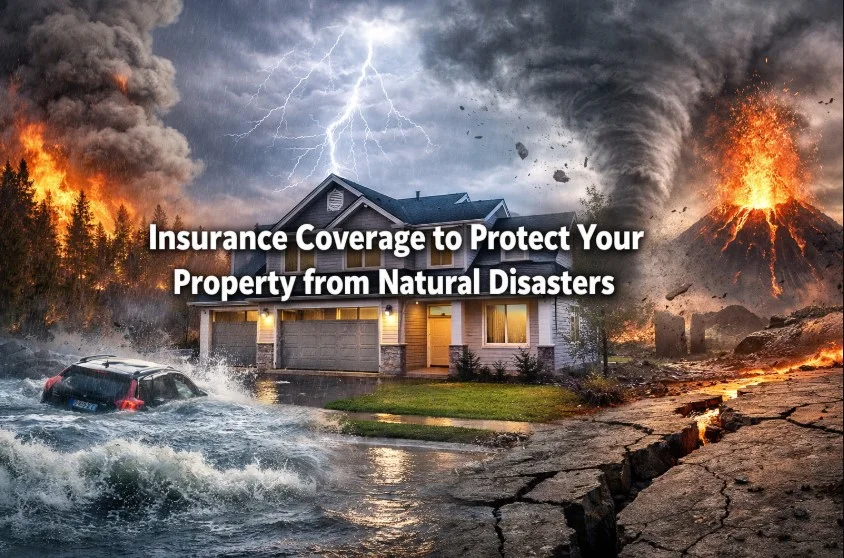
Finding the right insurance coverage to protect your property from natural disasters is one of the most critical steps a property owner can take to secure their financial future.
Insurance coverage to protect your property from natural disasters provides a necessary safety net that ensures you won’t be left with staggering rebuilding costs when nature takes an unexpected turn.
While many homeowners assume their standard policy covers everything, the reality is that “all-perils” coverage is rarely truly “all.” To truly safeguard your investment, you need to dive deep into the world of catastrophe insurance, riders, and policy limits.
This comprehensive guide will walk you through the essential components of protecting your home or business from the elements, ensuring you are never caught off guard.
Understanding Standard Property Insurance
In many instances, the first step in establishing a robust insurance coverage to protect your property from natural disasters is understanding the “perils” already included in a standard policy.
These standard protections act as the primary defense for your assets, yet they are often more nuanced than most owners realize.
While a standard policy is a powerful tool, it is essentially a list of specific promises; knowing exactly how these promises apply to fire, wind, explosions, and falling objects is the only way to identify where your safety net might have holes.
Fire and Lightning: The Core Protection
Fire remains the most feared peril for any property owner, and it is the cornerstone of any standard policy. This coverage typically extends beyond just the structural damage caused by active flames; it also covers the pervasive effects of smoke and the water damage resulting from firefighting efforts.
For example, if a wildfire approaches your property, the intense heat alone can melt siding or shatter windows without the structure ever catching fire, scenarios that are generally covered.
Lightning is treated as a separate but related peril; a direct strike can fry a building’s electrical system or trigger a fire instantly.
However, owners should be aware of “arson” exclusions and the fact that if a fire is caused by a catastrophic event not covered by your policy (like an earthquake in some regions), the fire damage itself might actually be excluded unless you have specific endorsements.
Windstorm and Hail: Guarding the Exterior Envelope
In the realm of insurance coverage to protect your property from natural disasters, wind and hail are the most frequent causes of claims. Standard policies are designed to protect the “envelope” of your building; the roof, siding, and windows, from high-velocity winds and the battering force of hailstones.
This usually includes damage from tornadoes and “straight-line” winds. A critical nuance here is the “wind-driven rain” rule: if wind breaks a window or punches a hole in the roof, the resulting water damage inside the house is covered.
However, if rain seeps through a poorly maintained roof that wasn’t actually damaged by the wind, the claim may be denied. Furthermore, in coastal areas, this coverage is often subject to higher deductibles or may even be excluded entirely, requiring a separate windstorm policy.
Explosion: Coverage for Sudden Internal and External Blasts
Explosions are a standard inclusion that many homeowners overlook until a disaster occurs. This covers damage from a variety of sources, ranging from a faulty water heater or furnace exploding in the basement to a gas leak in the kitchen.
The protection also extends to external events; if a nearby industrial plant or a neighbor’s property suffers an explosion that sends a shockwave through your home or showers it with debris, your standard policy’s explosion clause is what pays for the repairs.
It is important to distinguish this from “implosions” or gradual pressure changes, which might be excluded. As with fire, if the explosion is the result of homeowner negligence or lack of maintenance, the insurer may contest the claim.
Falling Objects: Protection from Above
The “falling objects” peril is what protects your property when gravity becomes an enemy during a storm. This is most commonly applied when heavy tree limbs or entire trees are brought down by wind, ice, or snow and crash into your roof or garage.
However, the scope is broader than just trees; it can include anything from a piece of a passing aircraft to a satellite falling from the sky. For the damage to be covered, the object must typically hit the exterior of the building first.
If a heavy vase falls off a shelf inside and breaks the floor, that is generally not a “falling object” claim. This coverage is essential for property owners with large, aging trees on or near their land, providing peace of mind that a single snapped branch won’t lead to a total financial loss.
Flood Insurance: The Most Common Exclusion
When it comes to insurance coverage to protect your property from natural disasters, there is no larger or more dangerous gap than the one left by flooding. Most property owners are shocked to learn, often when it is too late, that their standard “all-risk” policy explicitly excludes water damage caused by “rising water.”
This exclusion is not a minor footnote; it is a fundamental shift in how risk is handled in the insurance industry. Understanding why this gap exists, how it is defined, and the massive financial stakes involved is essential for any homeowner or business owner who wants to be truly protected.
The “Rising Water” Definition and Why It Matters
The reason insurance coverage to protect your property from natural disasters is so complicated regarding water is due to the strict legal definition of a “flood.”
In the insurance world, a flood is defined as a general and temporary condition of partial or complete inundation of two or more acres of normally dry land, or of two or more properties. This means if a pipe bursts in your upstairs bathroom and ruins your kitchen, it is “water damage” and is covered.
However, if a heavy rainstorm causes a nearby creek to overflow and that water enters your kitchen from the ground up, it is “flood damage” and is completely excluded from a standard policy.
This distinction is critical because even a single inch of water can cause over $25,000 in damage, necessitating a specialized policy to handle the unique physics of rising water.
The Financial Risk of Remaining Uninsured
The financial consequences of lacking specific insurance coverage to protect your property from natural disasters like floods can be ruinous. Statistics from the NFIP indicate that just a few inches of water can require the total replacement of drywall, insulation, flooring, and electrical systems throughout the ground floor of a building.
Many people mistakenly believe that government disaster assistance will bail them out if they don’t have insurance. In reality, FEMA grants are designed for emergency basic needs and rarely exceed a few thousand dollars, nowhere near the $60,000+ average cost of a flood claim.
Without a dedicated flood policy, the burden of rebuilding falls entirely on the property owner’s shoulders, often leading to foreclosures or the total loss of the property’s equity.
NFIP vs. Private Market: Choosing Your Protection
Because private companies historically found flood risk too unpredictable to insure, the federal government stepped in to create the National Flood Insurance Program (NFIP). For decades, this was the only way to get insurance coverage to protect your property from natural disasters involving water.
Today, however, a robust private flood insurance market has emerged. The NFIP offers stability and is available in all participating communities, but it has strict limits (typically $250,000 for the structure).
Private flood insurance can offer much higher limits, sometimes into the millions, and may include “loss of use” coverage to pay for hotel stays, something the government program does not provide. Choosing between them depends on your property’s value and whether you need more than just the basic structural protection.
The Mandatory Waiting Period: Why You Can’t Wait
Perhaps the most dangerous aspect of seeking insurance coverage to protect your property from natural disasters is the “waiting period” associated with flood insurance. Unlike auto insurance, which can often be started the same day, most flood policies have a mandatory 30-day waiting period before they become active.
This is designed to prevent “panic buying” when a major storm is already on the radar. If you wait until a hurricane or a massive rain system is forecasted to buy a policy, you will likely find yourself unprotected when the water actually hits.
This makes flood insurance a proactive necessity; it is a shield you must forge during the sunny days so it is ready when the clouds eventually break.
Earthquake and Earth Movement Coverage
When it comes to insurance coverage to protect your property from natural disasters, earthquakes and general “earth movement” represent some of the most complex and potentially expensive gaps in a standard policy.
Many property owners assume that if the ground shifts, their insurance will automatically kick in. However, in the eyes of an insurer, “earth movement” is a broad category that includes everything from the sudden shock of a seismic event to the slow creep of a landslide or the sudden collapse of a sinkhole.
To be fully protected, you must understand that these events often require their own specific policies or endorsements, each with its own unique set of rules and financial requirements.
The Seismic Trigger: What Earthquake Insurance Covers
Earthquake insurance is a highly specialized form of insurance coverage to protect your property from natural disasters that focuses strictly on damage caused by the shaking and cracking of the earth during a seismic event.
This coverage is essential because the structural damage from even a moderate quake can be catastrophic, often compromising the very foundation of a building.
A dedicated policy typically covers the cost of repairing the main dwelling, replacing damaged personal belongings like furniture and electronics, and providing “loss of use” funds if the home is unsafe to occupy.
It’s important to note that while the quake itself is the trigger, most policies also cover aftershocks that occur within a specific window (usually 72 to 168 hours) as part of the same initial claim.
The “Earth Movement” Umbrella: Beyond Shaking
While earthquake insurance is well-known, it is actually a subset of a broader category known as “earth movement.” True insurance coverage to protect your property from natural disasters often requires looking at an “Earth Movement” or “Difference in Conditions” (DIC) policy, which covers perils that a standard earthquake policy might exclude.
This includes landslides, mudflows, and even “subsidence” (the gradual sinking of the ground). For instance, if a heavy rainstorm causes a hillside to collapse onto your property, a standard earthquake policy would not pay out because there was no seismic activity.
An earth movement policy, however, is designed to catch these types of ground shifts, ensuring that whether the land moves because of a tectonic plate or a saturated slope, your investment remains secure.
The Percentage Deductible: A Different Financial Reality
One of the most surprising aspects of seeking insurance coverage to protect your property from natural disasters involving the earth is how the deductibles are structured.
Unlike a standard fire or theft claim that might have a $500 or $1,000 flat deductible, earthquake and earth movement policies almost always use a percentage-based deductible.
This is typically calculated as 5%, 10%, or even 25% of the total insured value of the structure. For a property insured for $400,000 with a 15% deductible, the owner would be responsible for the first $60,000 of repairs.
This high “skin in the game” reflects the massive risk insurers take on for these events and emphasizes why property owners must have a liquid emergency fund or a specific savings strategy to bridge that gap when disaster strikes.
Key Exclusions: What Even Earthquake Policies Won’t Touch
Even with specialized insurance coverage to protect your property from natural disasters, there are boundaries you must recognize. For example, most earthquake policies will not cover “fire following” a quake (such as a gas line rupture), because that is usually handled by your standard homeowners policy.
Similarly, if an earthquake triggers a tsunami or a flood from a dam failure, those water-related damages are typically the domain of flood insurance.
Furthermore, “man-made” earth movement, such as shifting caused by nearby construction, fracking, or mining, is often explicitly excluded unless you have a policy that specifically names those risks. Understanding these boundaries ensures you don’t have a false sense of security and allows you to build a truly comprehensive shield for your property.
Hurricane and Windstorm Deductibles
In coastal and high-risk storm regions, the structure of insurance coverage to protect your property from natural disasters changes significantly, moving away from standard flat fees toward more complex, percentage-based deductibles.
This shift occurs because wind damage from massive atmospheric events represents a catastrophic risk that can affect thousands of properties simultaneously.
To balance this risk, insurers implement “Hurricane” and “Windstorm” deductibles that are specifically triggered by the intensity and classification of the weather event.
Understanding these nuances is vital, as the difference between a standard deductible and a hurricane deductible can equate to tens of thousands of dollars in unexpected out-of-pocket costs.
The Trigger Mechanism: Defining the Event
The application of insurance coverage to protect your property from natural disasters during a wind event is governed by “triggers.”
A hurricane deductible doesn’t just apply because the wind is blowing hard; it is legally activated only when the National Hurricane Center (NHC) or a similar meteorological authority officially declares a hurricane.
These triggers usually have a specific timeline, often starting when a hurricane watch or warning is issued and ending 72 hours after the warning is lifted.
If your roof is damaged by a strong but “unnamed” thunderstorm, your standard, lower deductible typically applies. However, once that storm is given a name or reaches hurricane status, the specialized, higher deductible takes over.
Percentage-Based Calculations: The Math of Disaster
Unlike a standard fire or theft deductible, which is usually a fixed dollar amount (e.g., $1,000), a hurricane deductible is almost always a percentage of the property’s total insured value.
For example, if your home is insured for $500,000 and you have a 5% hurricane deductible, you are responsible for the first $25,000 of repairs. This can be a staggering realization for property owners who have not reviewed their declarations page.
It is crucial to remember that this percentage is based on the limit of insurance on the building, not the amount of the damage. Even if you only suffer $10,000 in roof damage, if your deductible is $25,000, the insurance company will not issue a payment.
Hurricane vs. Named Storm vs. Windstorm Deductibles
To refine your insurance coverage to protect your property from natural disasters, you must distinguish between the three main types of storm-related deductibles.
- Hurricane Deductibles: Only apply to storms classified as hurricanes.
- Named Storm Deductibles: Apply to any event with a name (like Tropical Storm Alberto). These are broader and easier to trigger than hurricane deductibles.
- Windstorm/Hail Deductibles: The broadest category, applying to any wind event, whether it’s a tornado, a localized microburst, or a named hurricane. Knowing which one is in your policy is the difference between being covered for a “bad windy day” or only being covered for a “historic catastrophe.”
Frequency of Application: Per-Event vs. Per-Season
A critical detail in managing insurance coverage to protect your property from natural disasters is how often you have to pay the deductible. In some jurisdictions, laws dictate that a hurricane deductible can only be applied once per calendar year or season.
This means if your property is hit by two hurricanes in the same year, you only have to meet that high percentage deductible once. In other areas, however, the deductible may apply “per occurrence,” meaning every time a new storm arrives, your financial clock resets.
Checking your policy for “Single Season Deductible” language can prevent a secondary disaster for your bank account if nature decides to strike twice.
Secondary Disasters: Sewer Backup and Sump Pump Failure
When discussing insurance coverage to protect your property from natural disasters, many people focus exclusively on the “big events”, the howling winds or the rising river.
However, some of the most devastating and expensive damages are caused by “secondary disasters” that occur internally as a result of external weather conditions.
Sewer backups and sump pump failures are the perfect examples: they are often triggered by heavy rains or power outages, yet they are almost universally excluded from standard property and flood insurance policies.
Without a specific endorsement, you could find yourself wading through toxic “black water” while footing a five-figure bill for cleanup and restoration.
The Invisible Threat: Why Sewers Back Up During Storms
A sewer backup is a particularly gruesome consequence of severe weather that highlights the limits of insurance coverage to protect your property from natural disasters. When a massive rainstorm hits, municipal sewer systems can become overwhelmed by the sheer volume of water entering the pipes through manhole covers and cracked lines.
This creates immense pressure that forces raw sewage to reverse its path, pushing it back through your home’s lateral lines and into your basement drains, toilets, and sinks.
Unlike a “clean” flood from a burst pipe, this water is categorized as “Category 3” or black water, meaning it is highly contaminated with bacteria, viruses, and parasites.
Standard policies view this as a separate peril from “surface flooding,” making it essential to add a specific Water Backup and Overflow endorsement to your policy.
Sump Pump Failure: The Silence of the Storm
For many property owners, a sump pump is the primary line of defense against groundwater. However, this defense is incredibly fragile.
During the very natural disasters you are trying to protect against, the two things your pump needs most, electricity and mechanical reliability, are often the first to go. A power outage during a hurricane or thunderstorm renders a standard electric sump pump useless precisely when the water table is rising the fastest.
Even if the power stays on, the pump can suffer a mechanical failure from being overworked or get clogged by debris washed in by the storm.
In the context of insurance coverage to protect your property from natural disasters, a sump pump failure is often excluded unless you have the correct rider, as insurers expect you to maintain the equipment and have a battery backup system in place.
The True Cost of Cleanup and Decontamination
The financial stakes of ignoring these secondary perils when building your insurance coverage to protect your property from natural disasters are enormous. Because of the biohazardous nature of sewage, you cannot simply “mop up” after a backup.
Professional restoration teams must be brought in to remove saturated drywall, tear out carpeting, and use specialized antimicrobial chemicals to sanitize every affected surface.
Minor cleanup can cost between $2,000 and $5,000, while Major restoration, If the sewage sits for more than 24 hours or affects multiple rooms, costs can easily skyrocket to $15,000 or even $50,000 in severe cases.
Furthermore, the structural damage to your foundation or floor joists from standing wastewater can be permanent if not addressed immediately. An insurance endorsement for sewer backup typically costs as little as $50 to $250 per year, a tiny fraction of the potential out-of-pocket loss.
Navigating the Endorsement: Limits and Exclusions
Adding a rider for these perils is a smart move, but you must pay close attention to the “Limit of Liability” within that endorsement. Often, an insurer will offer a default limit of $5,000 or $10,000, which may sound like a lot but will be exhausted almost instantly in a serious backup scenario.
To ensure your insurance coverage to protect your property from natural disasters is actually sufficient, you should evaluate the value of your basement’s contents (furnaces, water heaters, electronics, furniture) and the cost of professional remediation.
Additionally, be aware that these endorsements rarely cover the replacement of the pump itself if it simply wears out due to age; they only cover the damage caused by the overflow.
Always check if your policy includes “Loss of Use” coverage for these events, which would pay for a hotel if the sewage contamination makes your home temporarily uninhabitable.
Conclusion
Securing the right insurance coverage to protect your property from natural disasters is not a “set it and forget it” task. It requires an honest assessment of your risks and a willingness to read the fine print of your policy.
By closing the gaps in your coverage today, you ensure that even if the worst happens, your path to recovery is clear and financially supported.
Don’t wait for the clouds to darken before checking your limits. Knowledge is your first line of defense, and a comprehensive policy is your second.